
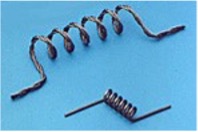
Applications:
Special windings for transformers, chokes, coils or sensors that have to function continuously in the low-voltage range at elevated temperatures of up to 500°C (peaks up to 1000°C). Various safety applications that have to withstand a fire of up to 600°C without destruction (mechanical heating, short circuit, heat risks, etc.).
Structure:
| Conductor: | Copper/nickel plating 27% |
| Other conductor materials on request. Special conductor materials provided by the customer can also be processed. Corresponding tests are carried out in the factory | |
| Insulation: | Ceramic in thicknesses of 5-20 µm |
| Color: | gray |
| Dimensions: | AWG 41 to AWG 18 or 0.07 mm to 1.0 mm |
| Linear density: | Like that of copper = 8.92 kg/dm3 per km |
| Nickel migration: | At temperatures >315°C, the KD500 is subject to nickel penetration into the copper. This effect is negligible with larger diameters but considerable with wire diameters <0.15 mm (AWG 34) after an operating time of 48 hours with the consequence of an increase in resistance. |
Heat resistance:
Permanent -90°C to +500°C (2500 hours min.) Short-term up to 800°C (tested for 10 days or 240 hours) and peaks up to 1000°C.
Electrical values:
Test voltage 150V AC, corresponding to 212V DC, test with rolled wire Bending radius = 20 x diameter. For bending radius < 20 x diameter please enquire Breakdown voltage >150V AC Resistance max. 3.10-6 Ω.cm at 20° C after ageing at 500°C
Further properties
| Moisture resistance | The ceramic is sensitive to moisture. It may need to be impregnated in the finished state. |
| Chemical resistance: | The ceramic is highly resistant to solvents and organic oils |
| Radiation resistance | High Resistance. |
| Flammability: | Non-flammable. At temperatures >1000°C the wire can melt but not burn. |
| Bending radius: | 5x outer diameter (see table) |
| Halogen-free: | Yes |
| Outgassing: | None |
Precautions of use
Ceramic is very different from traditional insulations. It is a rigid, hydrophilic material that requires special care when using. The KD 500 ceramic wire must be handled with care, without mechanical mistreatment (folding, traction, etc.).
Storage
The KD 500 ceramic wire must be stored in a dry environment.
Winding
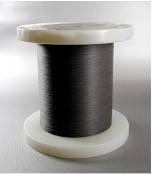
We recommend using a motorized unwinder controlled by a dancer or a movable pulley, unspooling in a horizontal orientation. The wire must be wound at a constant speed to avoid any back-and-forth jerking. The wire should not be subjected to torsional stress during winding. The wire should not scrape fixed parts (example: wire guide, the wires against each other). The maximum force should remain constant and comply with the recommendations in the table above.
How to strip the wire
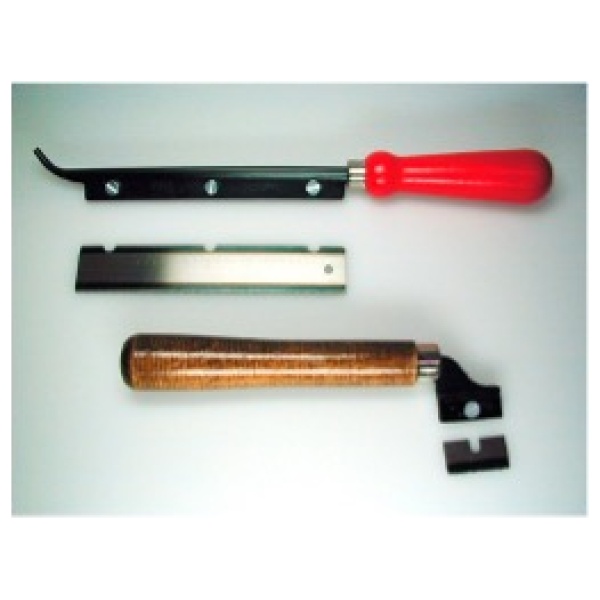
The layer of ceramic insulations is very thin and adherent to the conductor, standard stripping tools cannot be used. The insulation must be removed by abrasion by rubbing with sandpaper with very fine grain is recommended for all models.
Connection
The conductor of the KD 500 ceramic wire is made with nickel-plated copper. It can be connected in various ways:
> By silver brazing
> By splicing or wrapping
> After installation
Remarks
After installation the KD 500 ceramic wire must no longer be subjected to movement or mechanical stress. If vibrations occur during use, it is recommended that the winding be embedded in refractory cement. The KD 500 ceramic wire should not be subjected to moisture.
Dimensions:
| Item number | Diameter [mm] | AWG Size | Outer diameter [mm] | Weight [g/km] | Length [m/ kg] |
| KD500/007RR | 0,07 | 41 | 0,091 | 34 | 29 800 |
| KD500/010RR | 0,10 | 38 | 0,118 | 71 | 14 000 |
| KD500/012RR | 0,12 | 36 | 0,138 | 101 | 9 901 |
| KD500/015RR | 0,15 | 34 | 0,168 | 161 | 6 210 |
| KD500/017RR | 0,17 | 33 | 0,188 | 202 | 4 950 |
| KD500/020RR | 0,20 | 32 | 0,218 | 286 | 3 500 |
| KD500/025RR | 0,25 | 30 | 0,268 | 446 | 2 240 |
| KD500/030RR | 0,30 | 28 | 0,319 | 637 | 1 570 |
| KD500/035RR | 0,35 | 27 | 0,369 | 862 | 1 160 |
| KD500/040RR | 0,40 | 26 | 0,419 | 1 136 | 880 |
| KD500/045RR | 0,45 | 25 | 0,469 | 1 433 | 698 |
| KD500/050RR | 0,50 | 24 | 0,519 | 1 754 | 570 |
| KD500/055RR | 0,55 | 23 | 0,569 | 2 105 | 475 |
| KD500/060RR | 0,60 | 22 | 0,619 | 2 500 | 400 |
| KD500/065RR | 0,65 | 22 | 0,669 | 2 899 | 345 |
| KD500/070RR | 0,70 | 21 | 0,719 | 3 356 | 298 |
| KD500/080RR | 0,80 | 20 | 0,820 | 4 348 | 230 |
| KD500/090RR | 0,90 | 19 | 0,920 | 5 814 | 172 |
| KD500/100RR | 1,00 | 18 | 1,020 | 7 194 | 139 |
| Diameter [mm] | Max. permissable tensile force (N) | Minim.bending radius [mm] | Resistance at 20°C [Ω/m] |
| 7/100 | 0,022 | 0,50 | 8,261 |
| 10/100 | 0,044 | 0,63 | 4,060 |
| 12/100 | 0,065 | 0,73 | 2,790 |
| 15/100 | 0,102 | 0,88 | 1,768 |
| 17/100 | 0,131 | 0,98 | 1,370 |
| 20/100 | 0,183 | 1,13 | 0,984 |
| 25/100 | 0,287 | 138 | 0,626 |
| 30/100 | 0,413 | 1,64 | 0,436 |
| 35/100 | 0,564 | 1,89 | 0,319 |
| 40/100 | 0,739 | 2,14 | 0,244 |
| 45/100 | 0,933 | 2,39 | 0,193 |
| 50/100 | 1,150 | 2,64 | 0,156 |
| 55/100 | 1,390 | 2,89 | 0,129 |
| 60/100 | 1,660 | 3,14 | 0,108 |
| 65/100 | 1,950 | 3,39 | 0,092 |
| 70/100 | 2,260 | 3,64 | 0,080 |
| 80/100 | 2,960 | 4,15 | 0,061 |
| 90/100 | 3,740 | 4,65 | 0,048 |
| 100/100 | 4,620 | 5,15 | 0,039 |